Ideogram 3.0 walkthrough focused on typography and style control
A practical review that is useful for understanding how Ideogram 3.0 is being judged on text rendering, realism, and style-reference workflows.

Focused on clean typography, brand graphics, prompt fidelity, and consistent style across title-heavy posters, logo directions, and design-led visual work.
Ready to create images
Generate in this workspace and the latest result will appear here with the supporting content below.
Ideogram V3 is Ideogram's latest public image model. Ideogram officially positions 3.0 around best-in-class photorealism, stronger prompt fidelity, crystal-clear typography, and more consistent styles across design-led image tasks. In practice, Ideogram V3 is the model you reach for when the image needs to carry readable text, stronger layout intent, and a more graphic-design-aware output than a generic image model usually gives.

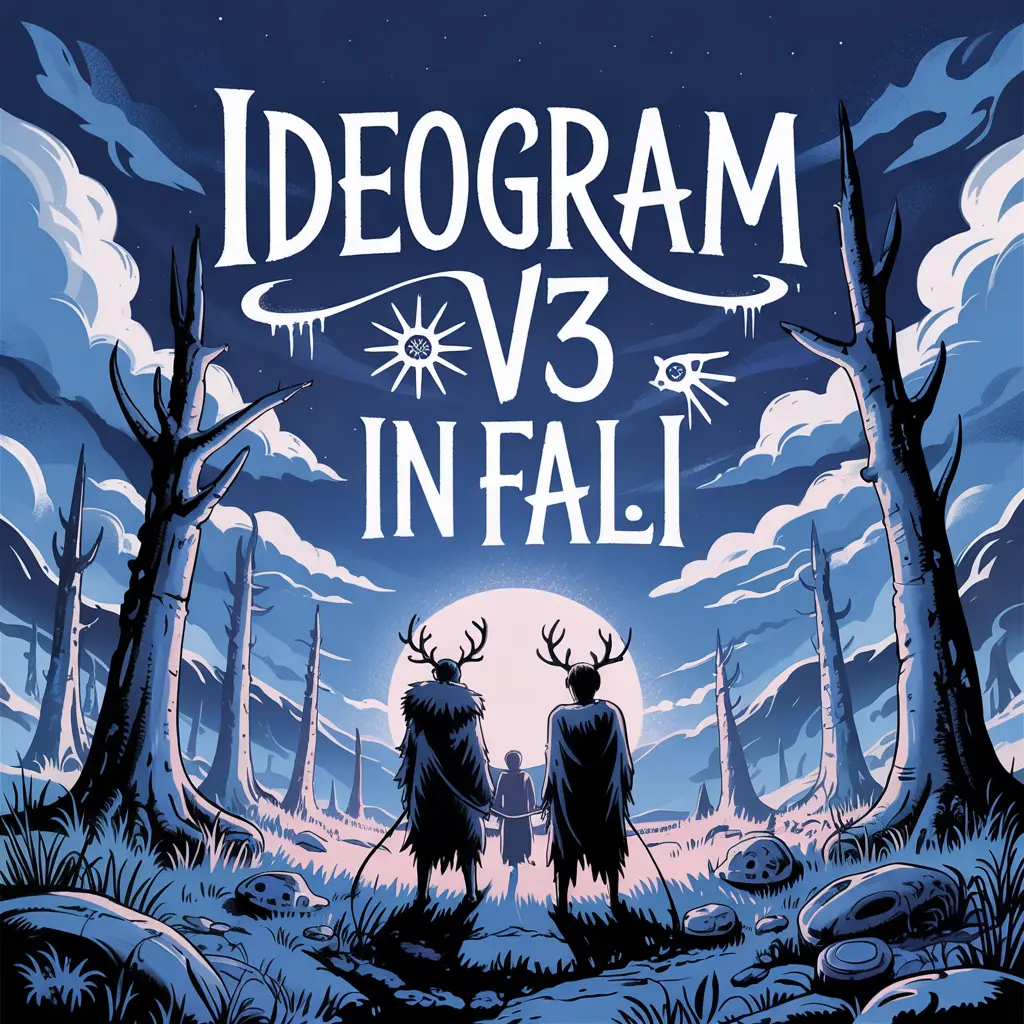
Ideogram V3 preview 1
Ideogram's official docs continue to treat text rendering as a defining strength. Ideogram V3 is especially useful when the generated image itself needs to contain usable headlines, logos, labels, or other visible copy.
Ideogram 3.0 is officially positioned around stronger prompt alignment. That matters when wording, object placement, and design intent need to stay closer to the original brief instead of drifting into loosely interpreted imagery.
Ideogram explicitly showcases logos, posters, landing page concepts, and other brand graphics as core use cases. This is the part that makes Ideogram V3 more naturally suited to graphic-design tasks than a generic realism-first model.
Official materials also highlight a major realism upgrade. Ideogram V3 is not only about text; it is also meant to produce more credible subjects, lighting, and spatial composition while preserving stronger layout structure.
Ideogram 3.0 introduces stronger style consistency as an official model goal. That makes it more useful when a series of outputs needs to feel visually related instead of looking like disconnected one-off generations.
Creator and review walkthroughs that are useful for understanding Ideogram V3 around typography, prompt fidelity, and design-aware image generation.
A practical review that is useful for understanding how Ideogram 3.0 is being judged on text rendering, realism, and style-reference workflows.

Useful as release-window context for how Ideogram 3 entered the wider AI tool conversation around realism and design workflows.
Helpful for understanding how creators use recent Ideogram capabilities in practical brand and product-style visual workflows.
Official launch and community references that help explain how Ideogram 3.0 is being framed around text accuracy, style references, and design-led creative work.
Describe the subject, visible text, composition, and graphic direction in the same prompt. Ideogram V3 works best when the prompt treats wording and visual hierarchy as part of the same design task.
In the current FreeGPT2 workbench, Ideogram V3 exposes image size, rendering speed, and style at generation time. Set all three before the first pass so speed, layout, and visual tone are aligned with the intended asset.
The current workflow exposes prompt expansion and negative prompts. Turn expansion on when you need Ideogram to enrich a loose idea, but keep it off when the prompt already contains tightly controlled layout or copy instructions.
After generation, check the text first for readability and placement, then review hierarchy, spacing, and the overall graphic logic. With Ideogram V3, the right evaluation standard is not just whether the image looks good, but whether the design reads clearly.
Ideogram V3 is strongest when the image needs readable text, stronger layout logic, and a more design-aware output than a generic photo-first model typically provides. It is less about raw image realism alone and more about realism, typography, and visual hierarchy working together.
Use Ideogram V3 for event posters, campaign covers, title-led social graphics, and other assets where the wording belongs inside the image rather than being added later.
It is a strong fit for slogans, logo directions, promo graphics, and other graphic-first concepts where text and visual form need to be developed together.
Use it for quote cards, headline images, announcement visuals, and other social assets where typography is a core part of the final deliverable.
Ideogram V3 is useful when a design-heavy image needs another pass through render speed, style selection, prompt expansion, or negative prompts rather than a complete model switch.
Each generation with Ideogram V3 consumes credits inside FreeGPT2.
Processing time varies with rendering speed, prompt complexity, selected style, and queue state.
Use the active workflow cost shown on the page as the current Ideogram V3 credit reference. In the current implementation, higher-quality render settings and denser design prompts can both increase total time.
In the current FreeGPT2 workbench, Ideogram V3 mainly exposes image size, rendering speed, style, prompt expansion, and negative prompts.
Start with free credits on sign-up. Upgrade only when recurring production, private generation, or higher volume starts to matter.
For lighter recurring creation.
Switch fixed steps to match your monthly output.
3,000 credits/month
Up to 12,000 images
Up to 996 videos
Higher monthly capacity
No watermark
Private generation
Faster speed
Image and video workflows
Try the core flow before you upgrade.